Showing posts with label Central Region - Cordoba. Show all posts

3 - On the way of the Jesuit estancias (Jesus Maria)

The local Indian tribes called them “Guanusacate”. These lands at the feet of the Sierra Chica Eastern slope , in the north of Cordoba, were conquered by the Spanishes at the beginning of the XVIIe century. In 1618, their owner, Don Gaspar de Quevedo, sell them to the Society of Jesus. Quickly they take the name of “Jesus Maria”. Their fertility, the arrival of many Indian workmen (114 in 1747) allow to the property to garner increasingly prolific harvests. The book of account of the Father Superior Antonio Machoni, take 48000 vine-feet, 65 pear trees and gathering of 6000 ognons in account. He mentions the existence of two mills, a tank and speaks about many cattle heads. Equipped in priority with rooms and storages, the estancia “Jesus Maria” only had very tardily a chapel. The Father Antonio Castillo, in a letter sent to the Father Jose Rodriguez explains to him that he has just sent masons to work on the building site of the church. We are in 1763, a few years before the expulsion of the Jesuits (*).During the XIXe century, the estancia received historical figures of Argentina : San Martin, Belgrano, Lavalle, Sarmiento.

(*) article "The Jesuit missions" (mai 2006)
Reference for the 3 articles "on the way of the Jesuit estancias" : "El camino de las estancias" de Carlos Page

Estancia La Paz (Ascochinga)

Contrary to San Martin, Julio Argentino Roca (1843-1914) is not what we can call a popular figure of the Argentinian history.
If some dedicated to him a certain admiration (the last owner of Estancia La Paz, the Roca family holiday house, tells that the best society ladies of Buenos Aires, had given an ivory covered book to him, to thank him for having saved colonist women and children from the “malones” of the Indians), others preserve of him the memory of the sanguinary chief of the “Campaign of the desert”.At that time, the colonial thrust, which find expression in the creation of new villages, exacerbates indeed tensions with the indigenous community, in particular with the people Mapuche (Araucans). President Avellaneda, in power since 1874 entrusts Alsina then Roca with the responsibility to subdue the Indian tribes organized in confederation under the authority of Cacique Namuncurà.The zeal with which Roca fulfills his mission (*) allow to obtain very quickly a lasting peace in the most southern areas and to put forward the sovereignty of Argentina in Patagonia.With these successes, Roca reaches the power in 1880. He will stay at the head of the country until 1884. The collective memory remembers his time like that of “generation 80's” marked in the cultural sphere by a certain fascination for France.Many haussmannians architects and landscape designers (**) are invited to give to Buenos Aires a resemblance of Paris. In the high society, established already at the edge of Rio, in the northern districts , in San Isidro, it is of good form to speak French. Town centre large colonial houses were deserted by their occupants in 1871, at the time of the yellow fever epidemic, and most of them became the reception buildings (conventillos) for penniless immigrants.Paradoxically, manners remain very strict. On the Mar del Plata beaches, men do not have the right to be less than 30 meters from the women and the sale of telescopes is prohibited.Roca will recover the power in 1898. His mandate, which will end in 1904, will be marked by frontier tensions with Chile, to which a certain Francisco Pascasio Moreno (*) will try to find solutions.

(*) Article “the glacier Perito Moreno” (février 2006)
(**) Article "Jean-Charles Thays" (août 2006)

Estancia La Paz
www.estancialapaz.com
(00 54) 35 2549-2073

Jean-Charles Thays, a French landscape designer in Argentina

Filled with wonder by landscapes he sees and people he meets, Jean Charles Thays decides one day of 1889, whereas he is 40 years old, to remain in Argentina.Favorite of Edouard André (politician and French collector of the Second Empire, whose private mansion is today the Museum Jacquemart-Andre in Paris), he is very quickly promoted Director of Parks and Promenades of Buenos Aires by the authorities of the city.His creations then translate the spirit "Belle Epoque" into vogue in Paris. he settles down quickly to what will remain without any doubt, his two major works: the Botanical Garden and the Park of Palermo.The direction of the perspectives, the omnipresence of artificial lakes and islands in the middle of the gardens he composes, the dissymmetry of the plantations, singularly reminds of the Bois de Boulogne, de Vincennes or the Park of Buttes-Chaumont in Paris. Only the species of trees differ.He will leave his impress in most of the large towns of Argentina:
- In Buenos Aires the "parques" Centenario, Patricios, Barrancas de Belgrano, the places Constitución, Congreso et Mayo
- In Cordoba, the "Parque" Sarmiento,
- In San Miguel de Tucuman, the "parque" 9 de Julio,
- In Santa Fé, the "Parque" Juan de Garay,
- In Mendoza, the "Parque" San Martin,...Some Argentinian dignitaries will call upon his talent for the plannings of the gardens of their private residences. It is the case of President Roca for the park of his Estancia "La Paz" in Ascochinga (Pcia de Cordoba).Jean Charles Thays become Carlos Thays dies out in 1934 in his adopted town : Buenos Aires.

2 - On the way of the Jesuit estancias (Santa Catalina)

60 kilometers north from Cordoba is the most important estancia which had belonged to the Order Jesuit during XVIIth and XVIIIth centuries in this area: that of Santa Catalina. It will sustain the part of head office and noviciate.The Fathers Jesuits acquired it in 1622 to an officer blacksmith, Luis Frasson. This one had given it the name of Santa Catalina in honor of Egypt Saint of IVth century.Very quickly, they completed many works, in particular underground canalisations. Some remaining writings testify to the existence of the church in 1754. In 1763, provincial Andreu counts 406 farm labourers working on the Santa Catalina lands, 12000 cattle heads, 6000 sheep and does not specify the number of mules.Expelled in 1773, the Jesuits leave to the new land lord, Don Francisco Antonio Diaz, many documents which will enable him to continue the project they had. The facade probably created by the famous architect Antonio Harls, takes again the simple and soft baroque lines wanted by the Fathers. 3 cloisters, a noviciate, warehouses are thus added.

1 - On the way of the Jesuit estancias (Alta Gracia)

Apart from the fact that it is the only mountainous massif for many kilometers round, a little like an island in the middle of the ocean, the Sierras presents the particularity of concentrating a religious inheritance of great interest inside a perimeter of a few tens of kilometers.The geographical situation of Corboda, founded in 1573 by Don Jeronimo Luis de Cabrera (*), explains establishment of religious buildings of this width. Indeed, built on well irrigated and fertile grounds, halfway on the road which binds Upper Peru to the Atlantic Ocean, the new city is not long in attracting the adventurers of any kind: farmers and tradesmen. Becoming owners of immense fields, certain colonists build quite as much immense residences too. If some clash with the Society of Jesus (the Jesuit Order), who wants to emancipate the Indians working on their lands (**), others motivated by pious reasons, hand down their property to it.These donations will allow the Order to live without depending on the charity of the “encomenderos” by allotting to each one of Estancias received a quite precise role: that of Alta Gracia, Jesus Maria, San Antonio and La Candelaria will be thus universities. That of Santa Catalina will accomodate the beginners and will be the seat of provincial administration of the Order. As for “reducciones” of North, in particular the San Ignacio one(**), they will be regarded a long time as places of retreat.The Estancia of Alta Gracia was baptized like this, in the honor of Holy Patrone of the native village of its giver, Don Alonso Nieto de Herrera, who bequeathed it to the Order in 1643. Started at the beginning of the XVIIIth century, the church was finished in 1762, a few years only before the expulsion of the Jesuits of the country (**). Losing its religious character it will be the property of several historical figures, like the Viceroy of Rio de La Plata, Marquis Rafaël de Sobre Montes, and especially the hero of resistance to the English invader (1806), Santiago de Liniers (***).
(*) article “Argentina during the XVIth century” (December 200()
(**) article “the Jesuit missions” (May 2006)
(***) article “the Pueyrredon house” (June 2006)

In the sky of the Sierras (El Mirador)

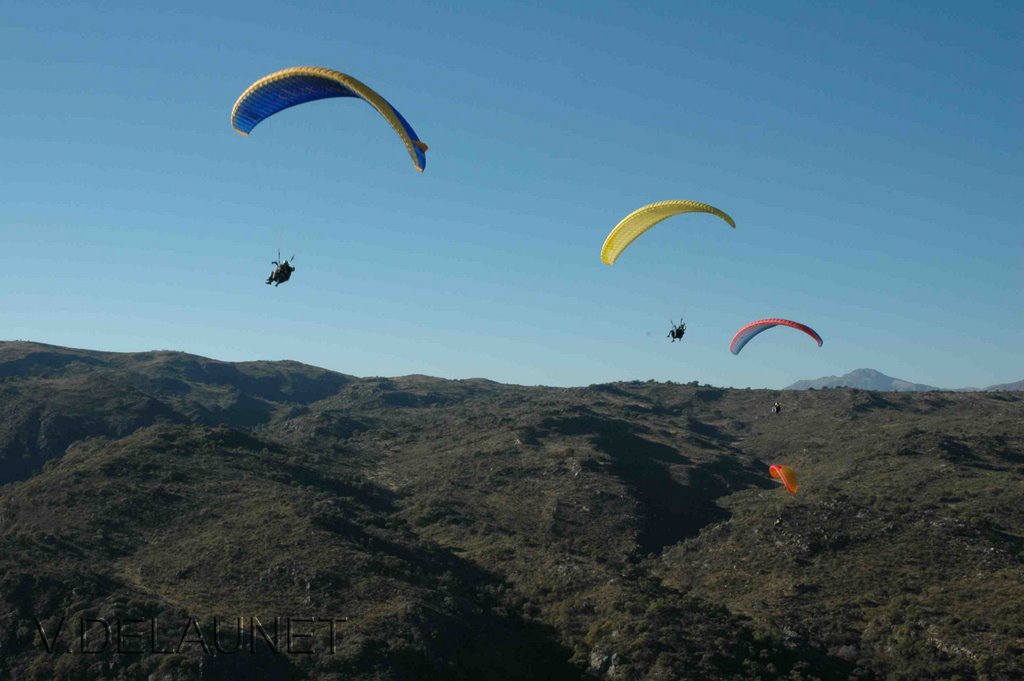
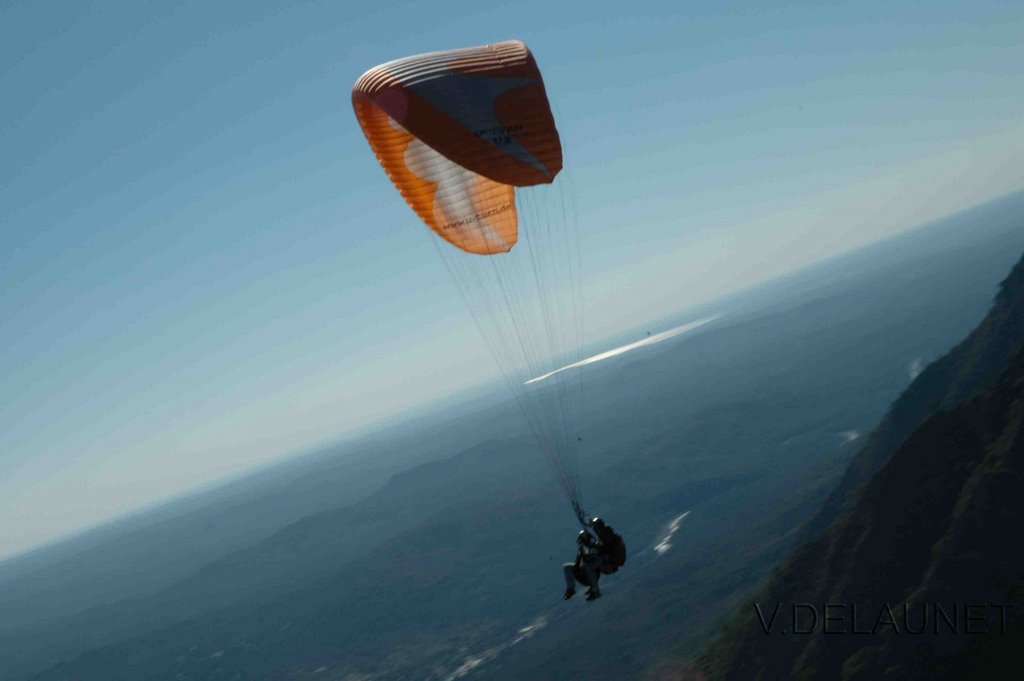
10 kilometers west from La Cumbre, in a place called Cuchicorral, you may live a few exceptional minutes. In this place, in the last western buttresses of the Cordoba Sierras, you will admire the sight up to the Rioja's desert vastnesses. Drawn by the Rio Pintos' meanders, the Cuniputo Sierra's sides, overlooked by Cerro Pendales (1300m) is used by the parapentists as an airstrip. Under a blinding sun, the pilots take you along in a ballet of multicoloured sails above virgin landscapes, to forget, during a few magic moments, the terrestrial attraction.

The "Potrerillo" of Larreta (Alta Gracia)

Everywhere else in the Sierras, the grass is yellow, burned ; sometimes even gray, of the dust raised by the cars while passing on the track. Here, it is green: of this english green that only assiduous work of an “jardineros” army can preserve.The “Potrerillo” is located in the middle of the landscape which surrounds it like an oasis in the middle of the desert. Surrounded by a reputed golf, planted on a rocky spur, it dominates convolutions of the "arroyo" which runs gently its waters.The effect is seizing and almost paradoxical in this universe of peeled hills, few kilometres from great poverty, the last “ cuadras” which precede the arrival in the “Potrerillo” being marked today out modest masonries.On ex lands of the estancia Jesuit of Alta Gracia, rises the house wanted by Enrique de Larreta (1875-1961). Of colonial inspiration, it locks up collections of objects, of furnitures, or paintings come from Upper Peru.
Ambassador of Argentina in France during the 1st world war, Larreta built a house to perhaps alleviate his memories marked by the horrors of the front he had had the occasion to visit.In this place favourable to the reflexion he wrote his major work: “La Gloria de Don Ramiro”.

Hosteria Potrerillo de Larreta
www.potrerillodelarreta.com
(00 54) 35 4742-5987

The quiet man (La Cumbre - Pcia de Cordoba)

Out of Internet world, he perhaps only knows of the global village and 21st century the poles of the "wire which sings".Slowly at the rhythm of the swaying step of his horses, he goes up and descends this track , only link which connects his lost hut to the nearest village.Af if he cames off one of Sergio Leone's movies, his stouping silhouette is profiled in the dust cloud that its horses hoofs raise. When the traveller, always hurried, meets his eyes protected from the sun by a bowler,he discovers a simple and kind glance and - who knows - perhaps amused by this gringo who never known taking time…After having greeted him of a frank smile, the quiet man carries on his road and leaves at the horizon only the mirage of his shade which merges soon with that of the poles.

The Cordoba's Sierras, an hinterland feeling (Pcia de Cordoba)

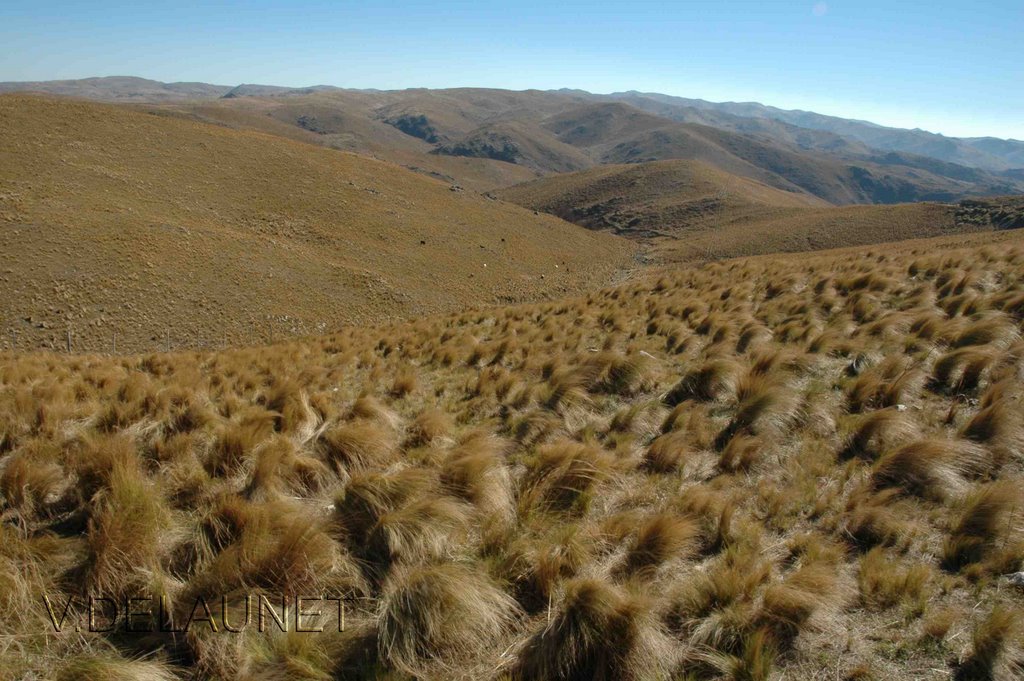
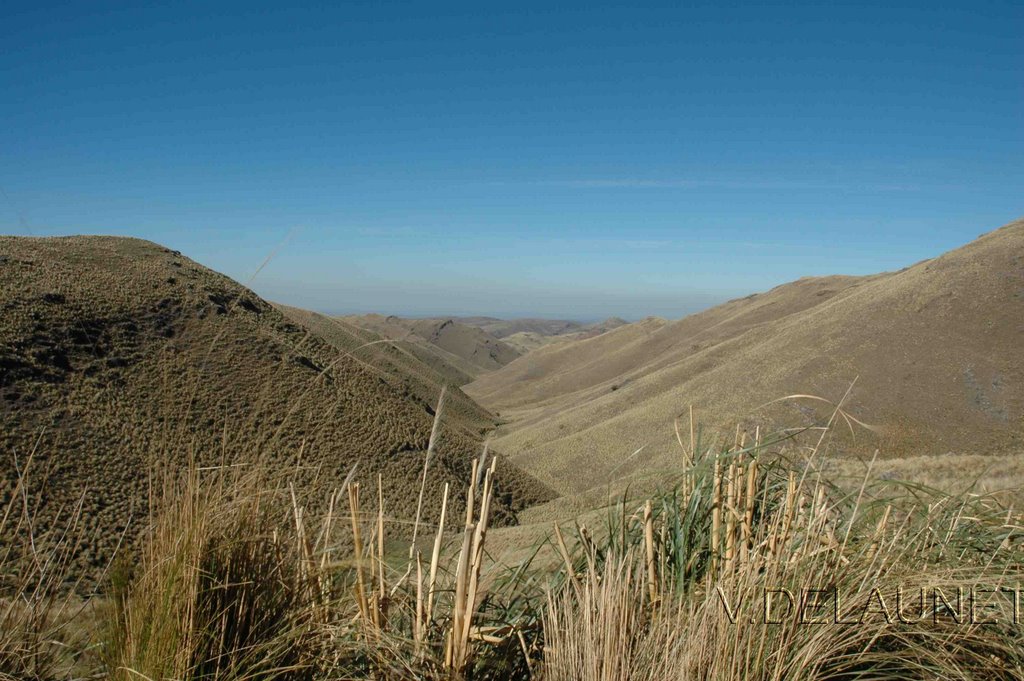
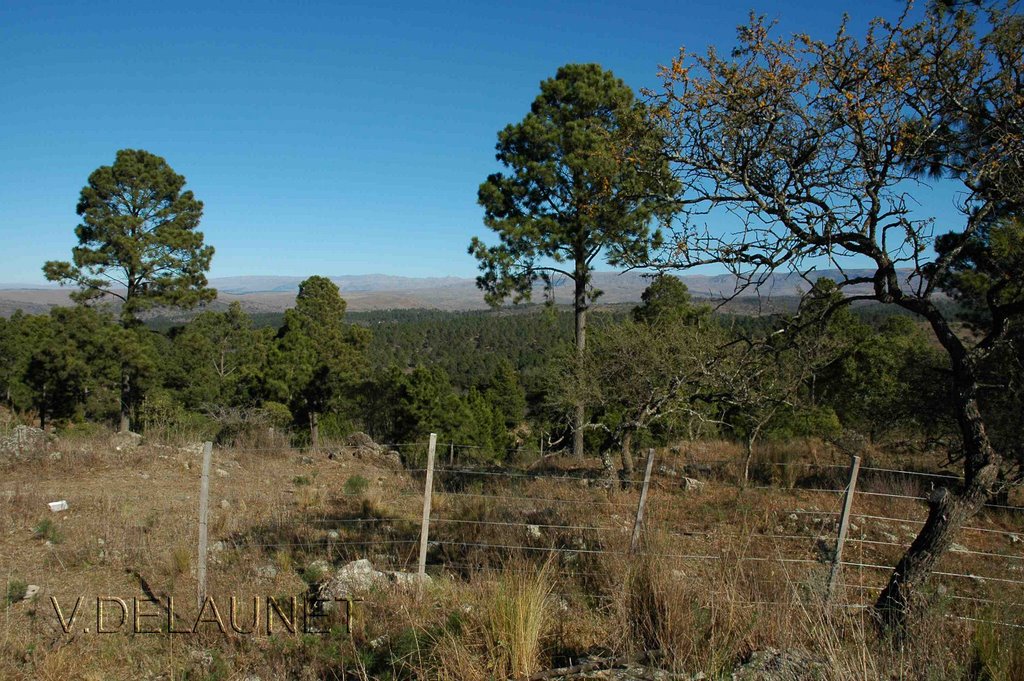
Apart from the usual tourist tours, the region of the central Sierras is addressed more to Argentinian in search of peace and silence.Less desorientating indeed that the provinces which border the Cordillera, that of Cordoba hides real treasures in the middle of its mountains: the Jesuits estancias of Alta Gracia, Jesus Maria or Santa Catalina, the ex-house of President Roca transformed into luxury estancia , strange villages of Bavarian style rested by the survivors of “Graf Spee”, a scuttled German cruiser in the Rio in December 40…From Buenos Aires, several access roads are possible. But it is inevitably necessary to cross the despairing “llanura” (plain) of the Pampa for nearly 800 kilometers and 9 hours of road before seeing the first spurs of Sierras. At the end of the road a landscape polished by time is revealed: soft slopes mountains covered with high yellow grasses giving the impression sometimes to be in the Provence hinterland. however, the length of the sinuous and dusty tracks quickly brings back the traveller to the dimension of great Argentinian spaces. The central part of the massif is covered or strewn with quebrachos and caroubiers forests. In altitude, the thistle prevails. More in the West the vegetation becomes more scattered. With the approach of the Cordillera, it gives way to the desert (these regions will be the subject of other articles) .